

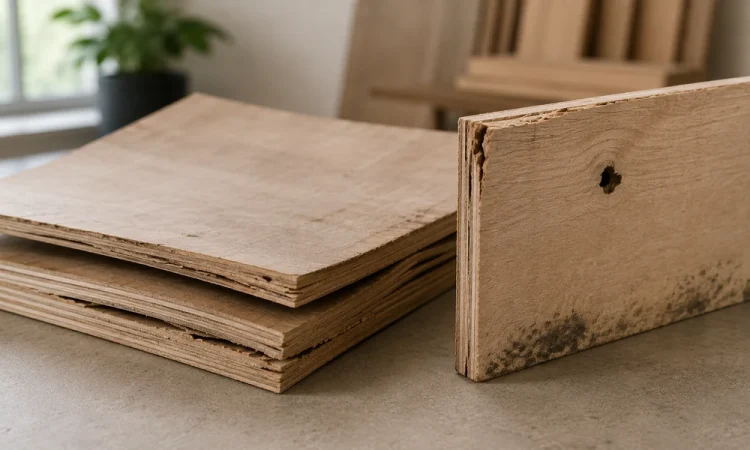
The material called plywood is popular for furniture, cabinetry, doors, dividers, and fixtures due to its strength and stability. Plywood products, however, do not perform the same way. Some may show issues with cutting, installing, or using. The information regarding the signs to watch can prevent losses incurred due to wood purchase.
Uneven Surface Texture
The texture of the surface is the first aspect to check. You need to feel the board and check it for roughness. One must be careful about the hot spots, the dents appearing here and there, and the surface quality – if there are too many flaws, it may mean that the manufacturing process was not good or that plywood is made from poor-quality wood.
Another warning sign is the knots that can be found in various places along the surface of the board. All of these flaws cause negative effects in the future if they are not repaired properly, as they will also not be easy to finish and cover.
Visible Gaps in the Core
The internal structure matters. Bad plywood will contain gaps inside its core. This void can be revealed when cutting the sheet.
Take a close look at the sides of the plywood sheet. The slats forming the core of the sheet must be glued together properly without having too many gaps. The resulting structure should be strong as well.
Warping, Bending, and Twisting
To see whether the plywood lies flat, place it on a level surface. If warped, bent, or twisted, the plywood may be unsuitable for use in furniture-making, cabinetry, or precise carpentry.
Warped plywood sheets cause problems in cutting and installation and may lead to misalignments in the final product. It is sometimes the way plywood was stored that contributed to its deformation; therefore, it is a good idea to check many sheets instead of relying on one panel to evaluate a whole batch.
Poor Bonding Between Layers
Plywood relies on strong adhesives to maintain veneer integrity. Therefore, delamination may indicate poor bonding strength if layers come apart from one another, peel off, or are lifted from edges. The problem becomes even more notable if plywood has to withstand wear and tear or high moisture levels.
It is important to select a plywood grade appropriate for the environment. In the areas that might be exposed to moisture, using moisture-resistant or waterproof plywood will ensure long-term durability.
Inconsistent Plywood Thickness
If possible, measure the thickness at different points. Significant discrepancies make cutting, joining, edging, and installing difficult. In furniture-making, inconsistent thickness can cause issues with joints and alignment, resulting in a wrong final look. A proper production process is characterised by tighter dimensional control. Therefore, it is advisable to compare the stated thickness with the actual indication of the sheet before purchasing.
Poor-Quality Face Veneer
Face veneer affects how wood looks and how well it performs when finished. Check whether there are any loose patches, excessive discolouration, deep cracks, rough patches, or poorly made repairs.
Natural variations do not necessarily indicate low quality; at the same time, excessive defects make finishing difficult. Good plywood manufacturers like Royale Touche demonstrate how plywood production and the quality of its surface impact performance.
Missing or Unclear Product Information
Missing information about plywood is another warning sign. When looking for the right product, one should know about the grade, thickness, manufacturer, intended use, and necessary specifications. Without enough information about all these points, it will be hard to assess whether certain plywood is suitable for particular applications.
When buying plywood, it is really important not to choose it solely based on its price. Cheaper plywood might have poorer quality and lower durability, which would result in greater expenses for repairs or replacements.
Examine the Plywood Before Buying
Before buying plywood, check its surface, edges, core composition, flatness, thickness, and bonding of veneers. Do not forget to ask about the grade and make sure it is appropriate for the intended application. In high-performance applications, specifications are crucial.
Spending several minutes checking the plywood will help avoid problems in the future. It will help distinguish between real quality and low-cost products.
Conclusion
Identifying the signs of poor plywood is important for making the right purchase. Rough surfaces, visible core gaps, warping, weak joints, different thicknesses, and unclear specifications should alert you. Choosing plywood according to its manufacturing process, suitability for the application, and enough product information will ensure durability and long-term use.